
Case Study
Enterprise Healthcare Ecosystem
A connected healthcare platform bringing patients, providers and administrative teams into one coordinated digital experience.
- 8 MonthsDelivery Timeline
- 16 MembersProject Team
- 5 InterfacesConnected Experiences

Project Overview
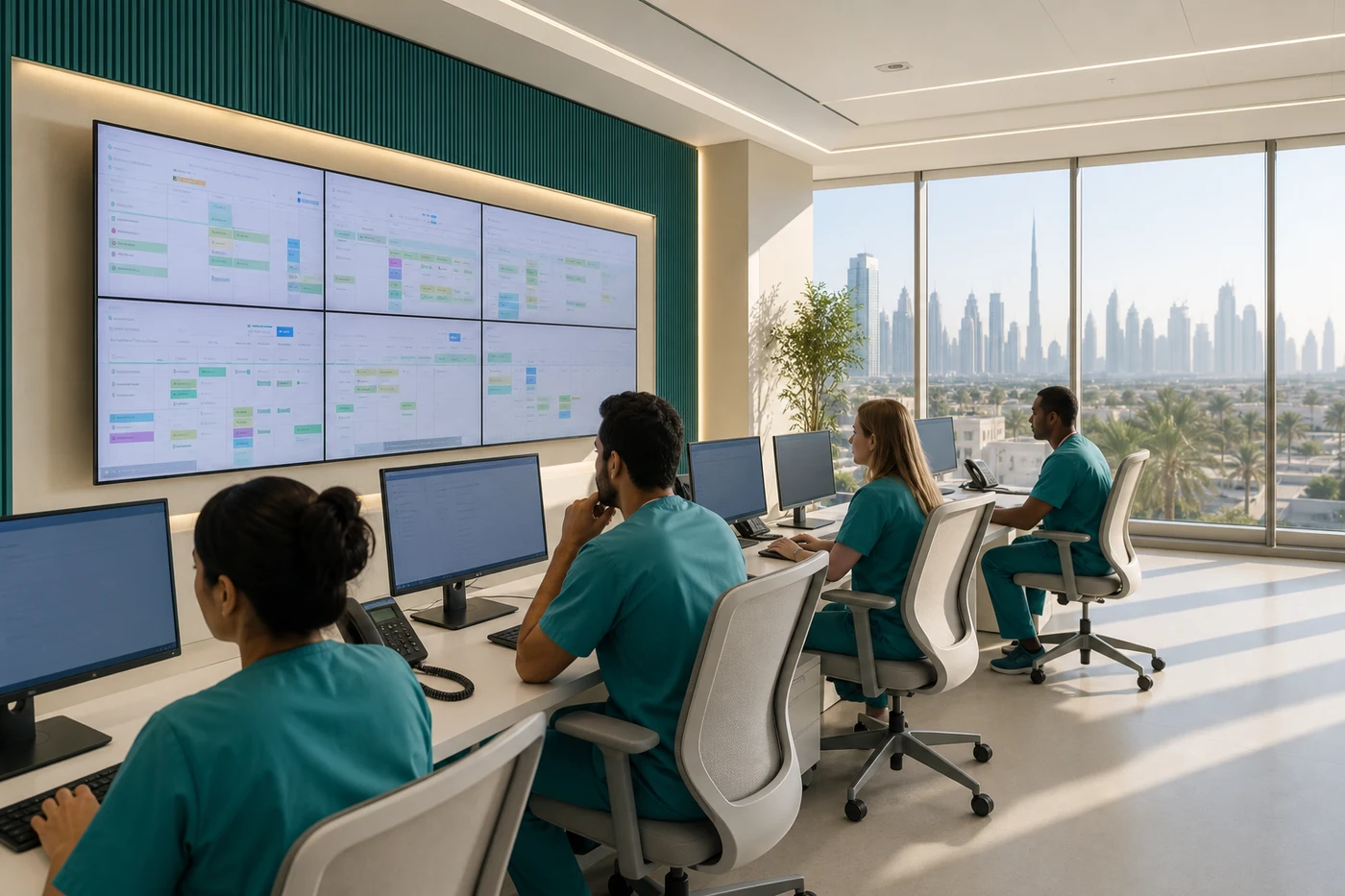
Enterprise Healthcare Ecosystem was developed for a private UAE healthcare operator managing patient services, provider workflows and administrative operations across multiple functions. The platform connected patients with healthcare providers while giving clinical and administrative teams structured tools for appointments, records, payments, service requests and operational reporting. Patients could manage appointments, review relevant information and communicate with care teams through mobile interfaces. Providers could manage schedules and patient related workflows through dedicated interfaces, while administrators had central oversight through the web environment. Techanic Infotech designed the platform around UAE healthcare operations, where clear information, timely coordination and controlled access are important across every stage of the patient journey.
Project Idea
The business idea was to bring disconnected healthcare activities into one coordinated digital environment. The operator needed a platform that could support patients, providers and internal teams without forcing each group to work through separate systems for related healthcare processes.
Patients often interact with several parts of a healthcare organisation during one episode of care. They may need to find a provider, book an appointment, receive updates, review information and complete a payment. Meanwhile, providers need accurate schedules and patient information, while administrative teams need visibility across appointments, requests and operational activity.
Techanic Infotech connected these journeys through shared services and role based interfaces. Patients could manage appointments and relevant healthcare information, providers could work with schedules and patient workflows, and administrators could monitor activity from a central web environment. Shared records helped keep information consistent as tasks moved between different users.
The product principle focused on accessibility, trust and control. Healthcare users need information presented clearly, while providers and administrators need dependable operational data. The experience was therefore designed to reduce unnecessary steps, make important information easy to find and maintain controlled access across different healthcare roles.

Challenges
The platform needed to serve patients with different levels of digital confidence alongside healthcare professionals who work under time pressure. A patient booking an appointment for the first time needs straightforward guidance, while a provider managing a busy clinic needs fast access to schedules and relevant patient information. Both experiences had to remain clear without exposing unnecessary complexity.
Healthcare information also required careful organisation across appointments, provider profiles, patient records, payments and service requests. A change to an appointment could affect several users, including the patient, provider and administrative team. Techanic Infotech structured connected workflows so updates remained consistent across interfaces while role based access limited information and actions to the appropriate user.
Performance mattered during periods of concentrated healthcare demand, including morning appointment booking, clinic opening hours and busy weekend service periods. Patients needed responsive appointment searches and confirmations, while providers needed current schedules without delays. The platform was designed to keep common healthcare workflows responsive while maintaining clear status information for appointments, payments and service requests.

Project Milestones We Achieved
| Milestone | Tasks | Timeline | Responsible |
|---|---|---|---|
| Project Discovery and Planning | Mapped patient journeys, reviewed provider workflows, defined access roles and documented administrative requirements | Month 1 | Business Analyst and Product Manager |
| UI/UX Design | Designed patient journeys, provider schedules, appointment flows, payment screens and administration interfaces | Month 2 | UI UX Designer and Product Designer |
| Core Development | Built mobile interfaces, healthcare services, appointment management, patient workflows and administrative capabilities | Month 3 to 5 | Flutter Developer and Backend Developer |
| Integrations and Testing | Connected healthcare services, notifications and payment systems, then tested workflows, permissions and exception scenarios | Month 6 to 7 | QA Engineer and Integration Engineer |
| Launch and Optimization | Prepared production environments, supported rollout, monitored usage patterns and refined high use healthcare workflows | Month 8 | Project Manager and DevOps Engineer |
Project Features
The platform was organised around the healthcare journeys that patients, providers and administrative teams handle most often. Each feature was designed to make information easier to access while keeping operational responsibilities clearly separated.
Patient Signup and Profile
Patients can create profiles, manage personal details, maintain contact information and access relevant healthcare services through one secure account.
Appointment Management
Patients can search available services, select providers, book appointments and review appointment details from a guided scheduling workflow.
Patient Information Access
Patients can review permitted healthcare information and relevant service details through a structured interface designed for easy navigation.
Provider Schedule Management
Providers can view schedules, manage appointment availability and access relevant patient information needed for their daily healthcare workflows.
Administrative Dashboard
Administrative teams can monitor appointments, manage users, review service activity and coordinate operational tasks through a central web dashboard.
Payments and Service Requests
Patients can complete supported payments and submit service requests while internal teams can track request status through connected workflows.

Results
Techanic Infotech delivered a connected healthcare platform across Android, iOS and Web, bringing patient services, provider workflows and administration into one coordinated environment. The platform gave the UAE operator a stronger digital foundation for managing routine healthcare interactions across several user groups.
The operational outcome was better visibility across shared healthcare workflows. Administrative teams could review appointments, user activity and service requests from one environment, while providers could work with structured schedules and patient information. This reduced the need to coordinate routine digital tasks through disconnected channels.
Patients received a more consistent experience for appointment management, healthcare information, payments and service requests. Providers gained clearer access to daily schedules and relevant patient information, while administrative teams had better oversight of activity moving through the platform. This created a more traceable process from appointment creation through completion.
The client can extend the platform with additional healthcare services, provider workflows and administrative capabilities without rebuilding the core system. The connected architecture provides a foundation for adding more locations, departments and digital services as the operator expands its healthcare operations across the UAE.

Development Process
Explore
- UAE healthcare behaviour
- Patient service expectations
- Provider workflow needs
- Patient journey mapping
- Provider process mapping
- Administrative workflow planning
Implement
- Clear patient navigation
- Guided appointment booking
- Focused provider controls
- Healthcare service layer
- Mobile interface development
- Web administration
Execute
- Appointment scenario testing
- Access permission checks
- Workflow validation
- Production readiness checks
- User rollout support
- Usage monitoring
Typography & colors
Source Sans 3
ABCDEFGHIJKLMNOPQRSTUVWXYZ
abcdefghijklmnopqrstuvwxyz
1234567890
Primary
#0F766E
Secondary
#14B8A6
Tertiary Color
#CCFBF1
Icons Color
#111827
Text Color
#ffffff
Background Color
#ffffff
App Visuals
Family clinic
Consultation · FridayReference
#EH441Stay up to date with care alerts
HealthNet
Care across your network
You are almost there
Tech Stack
The technology stack was selected to support high traffic service searches, responsive appointment scheduling, secure data handling and a consistent mobile and web experience. Flutter powered the mobile interfaces, NestJS handled backend services, PostgreSQL stored structured healthcare records, Redis supported fast access to active sessions and frequently requested data, and AWS provided the infrastructure for deployment, monitoring and controlled scaling.
- Flutter
- NestJS
- PostgreSQL
- Redis
- AWS
Have an Idea for a Scalable Platform?
Techanic Infotech can build connected healthcare platforms around patient needs, provider workflows and operational requirements.
Talk to Our Experts