
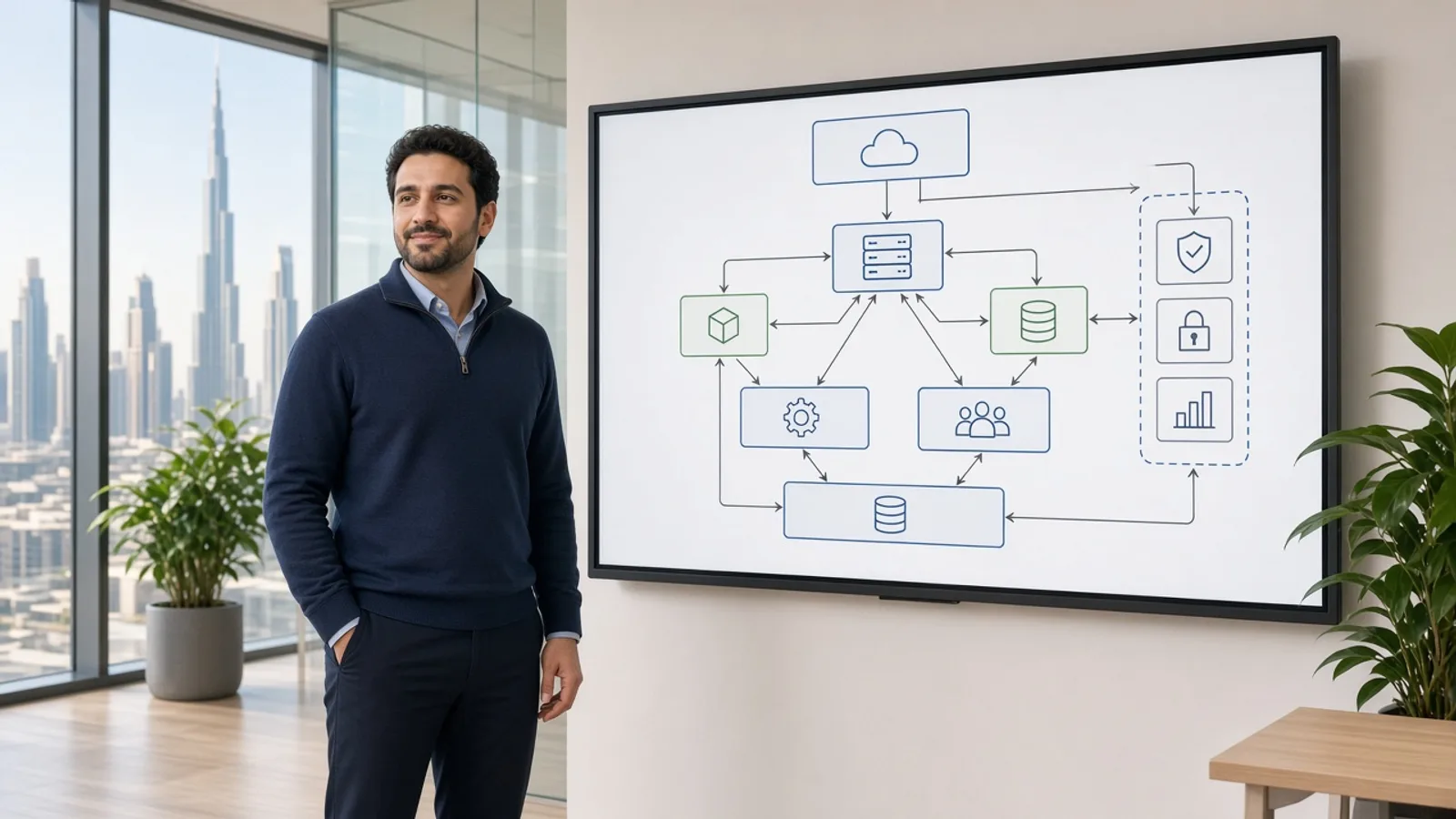
Key Takeaways
- Bridges business and technology: A solutions architect translates business requirements into practical technical solutions.
- Designs the overall architecture: They determine how applications, databases, APIs, cloud infrastructure, and integrations should work together.
- Supports development teams: Architects provide technical direction and help resolve complex implementation and architectural challenges.
- Plans for long-term growth: Scalability, security, performance, maintainability, and future requirements are considered during architecture planning.
- Adds value to complex projects: Their expertise is particularly useful for enterprise systems, major integrations, cloud transformations, and technology modernization.
Modern software projects often involve multiple technologies, business requirements, integrations, security considerations, and development teams. Without a clear technical direction, these elements can become difficult to manage as a project grows.
This is where a solutions architect plays an important role. They analyse business requirements and translate them into practical technical solutions by designing the overall architecture of a software system.
From selecting technologies and defining integrations to planning scalability and supporting developers, solutions architects help ensure that different parts of a software project work together effectively. Their responsibilities can vary depending on the project's size, industry, and technical complexity.
Understanding what a solutions architect does can help businesses and development teams determine when this role is needed and how it contributes to building reliable, scalable, and maintainable software.
What Is a Solutions Architect and Why Is the Role Important?
A solutions architect is a technology professional who designs the overall technical solution for a software project based on business requirements. They connect business objectives with technical implementation by determining how applications, databases, APIs, cloud infrastructure, security systems, and other components should work together.
Unlike a developer who primarily focuses on implementing specific features, a solutions architect looks at the bigger technical picture.
Connecting Business and Technology
One of the main responsibilities of a solutions architect is translating business requirements into technical specifications. They work with stakeholders to understand what the organization needs and then determine how technology can support those goals.
For example, a business planning custom software development may need a platform that can handle increasing users, connect with existing systems, and support future features. The solutions architect helps define an architecture capable of meeting these requirements.
Designing the Overall Solution
Solutions architects determine how different components of an application should interact. This can include frontend applications, backend services, databases, APIs, cloud infrastructure, authentication systems, and third-party platforms.
Their decisions create a technical blueprint that gives developers a clear direction during implementation.
Supporting Long-Term Technical Decisions
A solutions architect does not focus only on getting an application launched. They also consider how the system will perform and evolve after deployment.
Technology choices are therefore evaluated based on factors such as maintainability, scalability, security, performance, development resources, and expected future requirements.
What Does a Solutions Architect Do When Designing Software Solutions?
A solutions architect is responsible for turning business requirements into a practical technical solution. Their work spans planning, architecture, technology selection, integrations, security, and collaboration with development teams.
1. Understanding Business Requirements
The architect first works with stakeholders to understand the project's goals, target users, business processes, functional requirements, and expected outcomes. They identify technical requirements that may affect the solution, such as performance, scalability, security, budget, and integration needs.
2. Designing Software Architecture
After understanding the requirements, the solutions architect creates the overall technical architecture. They determine how the frontend, backend, databases, APIs, cloud infrastructure, and external services should interact.
3. Selecting Technologies and Tools
Solutions Architects evaluate programming languages, frameworks, databases, cloud platforms, APIs, and development tools based on the project's needs. They consider factors such as performance, security, development complexity, compatibility, scalability, and long-term maintenance.
4. Planning System Integrations
Modern applications rarely operate independently. They often need to connect with CRM platforms, payment gateways, analytics tools, communication systems, enterprise applications, or third-party APIs.
5. Supporting Development Teams
Solutions Architects provide technical direction throughout development. They may review architectural decisions, clarify technical requirements, identify potential risks, and help developers resolve complex implementation issues.
6. Planning for Security and Scalability
Security and scalability are considered from the beginning rather than added after development. The architect helps define authentication, authorization, data protection, infrastructure requirements, monitoring, and other controls.
Key Responsibilities of a Solutions Architect Across a Software Project
A solutions architect is involved in multiple stages of a software project, from initial planning to deployment and ongoing improvements. Their responsibilities may vary by organization, but the following areas are commonly part of the role.
| Responsibility | What It Involves |
|---|---|
| Business Requirement Analysis | Understanding business objectives and translating them into technical requirements |
| Architecture Design | Creating the overall structure of applications, services, databases, and infrastructure |
| Technology Selection | Evaluating frameworks, programming languages, databases, cloud platforms, and tools |
| Integration Planning | Designing connections between internal applications, APIs, and third-party systems |
| Security Planning | Defining authentication, authorization, encryption, and data protection requirements |
| Scalability Planning | Ensuring the architecture can support increasing users, data, and workloads |
| Technical Documentation | Creating architecture diagrams, technical specifications, and implementation guidelines |
| Risk Management | Identifying technical risks and developing strategies to reduce them |
| Development Support | Guiding developers and resolving complex architectural or technical issues |
| Performance Planning | Establishing requirements for application speed, availability, and reliability |
| Cost Consideration | Balancing technical requirements with infrastructure, development, and operational costs |
| Architecture Review | Evaluating whether the implemented solution continues to meet technical and business requirements |
Translating Requirements Into Technical Plans
Solutions Architects evaluate what the business wants to achieve and determine the technical components required to deliver it. They break broad business objectives into specific architectural requirements that development teams can implement.
Creating Architecture Documentation
Clear documentation helps developers and stakeholders understand how the proposed solution will work. This can include system architecture diagrams, data-flow diagrams, API specifications, technology decisions, and integration plans.
Identifying Technical Risks
Architects assess potential problems before implementation, including outdated technologies, integration dependencies, security weaknesses, performance limitations, and scalability concerns. Identifying these risks early can prevent expensive changes later.
Coordinating With Development Teams
Solutions Architects work closely with developers, project managers, DevOps specialists, security teams, and business stakeholders. They provide technical guidance while ensuring that implementation remains aligned with the approved architecture.
For large projects, their role can be especially important in enterprise software development, where multiple applications, teams, integrations, and business processes need to operate within a coordinated technical environment.
What Does a Solutions Architect Do Throughout the Software Development Lifecycle?
A solutions architect can remain involved from the initial idea through deployment and future improvements. Their role changes as the project progresses, but the primary goal remains the same: keeping the technical solution aligned with business requirements.
Discovery and Planning
During the early stage, the architect analyses business objectives, user requirements, existing systems, technical constraints, and expected workloads. They help determine whether the proposed solution is technically feasible and what resources may be required.
Architecture and Technology Design
Once requirements are clear, the architect defines the system architecture and selects appropriate technologies. They determine how different components will communicate and establish standards that guide the development team.
Development and Implementation
During development, the solutions architect works with developers to ensure that implementation follows the intended architecture. They review important technical decisions and help resolve issues that could affect system performance, security, or scalability.
Testing and Quality Validation
Architects may contribute to technical testing by reviewing performance, integration, security, reliability, and scalability requirements. They help ensure that the completed solution meets the architectural objectives established during planning.
Deployment and Release
Before deployment, the architect reviews infrastructure, integrations, configuration, security controls, and operational requirements. They may work with DevOps teams to ensure that the application can be deployed and maintained reliably.
Post-Launch Improvement
The architect's responsibilities can continue after launch. They review system performance, identify architectural limitations, evaluate new technology requirements, and recommend improvements as business needs change.
Essential Skills Every Solutions Architect Should Have for Modern Software Projects
A successful solutions architect needs more than strong programming knowledge. The role requires a combination of technical expertise, business understanding, analytical thinking, and communication skills to design solutions that are practical and sustainable.
| Skill Area | What the Architect Needs to Understand |
|---|---|
| Software Architecture | Application structures, design patterns, microservices, and distributed systems |
| Programming Knowledge | Major programming languages, frameworks, and development principles |
| Cloud Computing | Cloud platforms, infrastructure, storage, networking, and scalable architectures |
| Database Management | Relational and NoSQL databases, data modelling, performance, and migration |
| API & Integration | REST APIs, authentication, third-party integrations, and data exchange |
| Cybersecurity | Security architecture, access control, encryption, and risk management |
| DevOps | CI/CD, infrastructure automation, monitoring, containers, and deployment practices |
| Problem-Solving | Analysing technical challenges and developing practical solutions |
| Communication | Explaining complex technical decisions to technical and non-technical stakeholders |
| Business Understanding | Connecting technology decisions with business objectives, budgets, and priorities |
Technical Architecture Knowledge
A solutions architect should understand how different software components work together. Knowledge of application architecture, databases, APIs, cloud infrastructure, distributed systems, and integration patterns helps them design reliable solutions.
Cloud and Infrastructure Expertise
Modern applications frequently rely on cloud infrastructure for computing, storage, networking, scalability, and deployment. Architects should understand major cloud concepts and know how infrastructure choices affect performance, security, and operating costs.
Security Awareness
Security should be considered throughout the architecture rather than treated as a separate development task. Solutions Architects need to understand authentication, authorization, encryption, secure APIs, data protection, and common application security risks. Businesses exploring cybersecurity services in Dubai often involve architects early so security controls are built into the design.
Business and Analytical Thinking
Technical decisions should support business objectives. Architects need to evaluate development effort, operational costs, risks, scalability requirements, and expected business value when comparing different solutions.
Communication and Collaboration
Solutions Architects regularly communicate with business leaders, developers, project managers, designers, and infrastructure teams. They must be able to explain complex architectural decisions clearly and build agreement around technical recommendations.
Solutions Architect vs Software Architect vs Technical Architect: What Is the Difference?
These roles can overlap, and organizations sometimes use the titles differently. However, their primary areas of responsibility are generally distinct.
| Role | Primary Focus | Typical Responsibilities |
|---|---|---|
| Solutions Architect | Business requirements and complete technical solutions | Designs end-to-end solutions, selects technologies, plans integrations, and aligns technology with business goals |
| Software Architect | Application and software structure | Defines application architecture, design patterns, components, APIs, and technical standards |
| Technical Architect | Technical implementation and infrastructure | Focuses on infrastructure, platforms, security, deployment, performance, and technical implementation |
Why the Roles Can Overlap
In smaller organizations, one professional may perform responsibilities associated with all three roles. Larger organizations may separate them across different specialists to manage complex systems and multiple development teams.
When Does a Business Need a Solutions Architect for a Software Project?
Not every software project requires a dedicated solutions architect. For smaller applications with limited functionality, an experienced development team may be able to manage the architecture internally. However, the role becomes increasingly valuable as technical and business complexity grows.
Complex Software Requirements
Businesses building platforms with multiple user roles, business workflows, databases, APIs, and third-party integrations can benefit from architectural planning before development begins.
Multiple Systems and Integrations
Projects that need to connect CRM, ERP, payment, analytics, communication, or other business systems often involve complex data flows. An architect can define integration patterns and identify dependencies before development starts.
Growing Scalability Requirements
If a business expects significant growth in users, transactions, or data, architecture needs to account for future workloads. A solutions architect can design infrastructure and application components that can scale without requiring a complete redesign.
Enterprise-Level Projects
Large organizations often have multiple applications, departments, databases, and development teams. Architectural guidance becomes important for maintaining consistency across the technology environment.
In these situations, a software development company may involve a solutions architect early to evaluate requirements, define the technical roadmap, and coordinate architectural decisions across teams.
Major Technology Transformation
Businesses replacing legacy systems, adopting cloud infrastructure, introducing AI, or modernizing their technology stack may require architectural expertise to manage the transition safely.
How Solutions Architects Support Modern Software Development and Delivery
Modern software development involves more than writing application code. Cloud infrastructure, automated deployment, APIs, security, data platforms, and multiple applications often need to work together. Solutions Architects help define how these components should be connected and operated.
Supporting Cloud-Based Architecture
Solutions Architects evaluate whether cloud infrastructure is suitable for the project and determine how computing, storage, databases, networking, and other services should be structured. Guidance from cloud-based custom software development practices often informs these decisions.
Working With DevOps Teams
Architecture decisions directly affect how software is built, tested, deployed, and monitored. Solutions Architects collaborate with DevOps teams to establish suitable deployment models, infrastructure requirements, monitoring strategies, and automation practices.
For businesses that need specialized DevOps services, architectural planning can help ensure that development and operations processes remain aligned with the application's technical requirements.
Enabling Scalable and Flexible Systems
Modern architectures often use approaches such as microservices, containerization, serverless computing, and API-driven development. A solutions architect evaluates these approaches based on the project's actual requirements rather than adopting them simply because they are popular.
Supporting Mobile and Web Applications
A business may operate several customer-facing applications that depend on the same backend services. A solutions architect can define APIs, authentication mechanisms, databases, and shared services so that web and mobile applications can communicate with the backend securely.
For example, a mobile app development company may work with a solutions architect to ensure that a mobile application can integrate efficiently with existing enterprise systems.
How to Choose the Right Solutions Architect for Your Project and Business Requirements
Choosing the right solutions architect depends on the complexity of the project, technology requirements, industry, and long-term business goals. The right professional should be able to understand both the business problem and the technical solution required to solve it.
Evaluate Technical Experience
Look for experience with the technologies relevant to your project, such as cloud platforms, APIs, databases, cybersecurity, microservices, mobile applications, or enterprise systems.
An architect should also understand how different technologies interact rather than being limited to a single programming language or framework.
Review Previous Projects
Ask about similar projects the architect has worked on and the technical challenges they handled. Experience with comparable applications can provide a better indication of their ability to manage your project's requirements.
Assess Business Understanding
A strong solutions architect should understand business objectives, budgets, timelines, user requirements, and operational constraints. They should be able to explain why a particular technical approach is appropriate instead of recommending technologies without considering the business context.
Check Communication Skills
Architecture decisions often need approval from both technical and non-technical stakeholders. Choose someone who can explain complex concepts clearly, document decisions effectively, and collaborate with developers, managers, and business teams.
Consider the Development Team
The architect should work effectively with the development team that will implement the proposed solution. If you are evaluating dedicated developers vs. an in-house team, consider how the architect will collaborate with either model and how technical leadership will be maintained throughout development.
Conclusion
A solutions architect plays an important role in turning business objectives into reliable and scalable software solutions. Rather than focusing only on individual features or code, they look at the complete technical ecosystem and determine how its different components should work together.
From selecting technologies and designing architecture to planning integrations, security, scalability, and deployment, their decisions can influence the success of a software project.
For businesses working on complex applications or large technology transformations, involving a solutions architect early can reduce technical risks, improve decision-making, and create a stronger foundation for long-term growth.
Frequently Asked Questions
1. What is a solutions architect?
A solutions architect designs technical solutions that connect business requirements with applications, infrastructure, databases, APIs, and other technologies.
2. What does a solutions architect do?
They analyse requirements, design system architecture, select technologies, plan integrations, address security and scalability, and guide development teams.
3. What skills does a solutions architect need?
They typically need knowledge of software architecture, cloud computing, databases, APIs, cybersecurity, DevOps, problem-solving, and communication.
4. Is a Solutions Architect the same as a Software Architect?
No. A solutions architect focuses on complete business and technical solutions, while a software architect primarily focuses on the internal architecture and structure of software applications.
5. When does a business need a solutions architect?
Businesses may need one when projects involve complex integrations, enterprise systems, cloud transformation, scalability requirements, or significant technology modernization.
6. Does a solutions architect write code?
They may write or review code when required, but their primary responsibility is designing the architecture and providing technical direction rather than handling day-to-day development.
7. How does a solutions architect help a development team?
They provide architectural guidance, resolve complex technical issues, evaluate technology choices, and ensure development remains aligned with the project's overall technical strategy.