
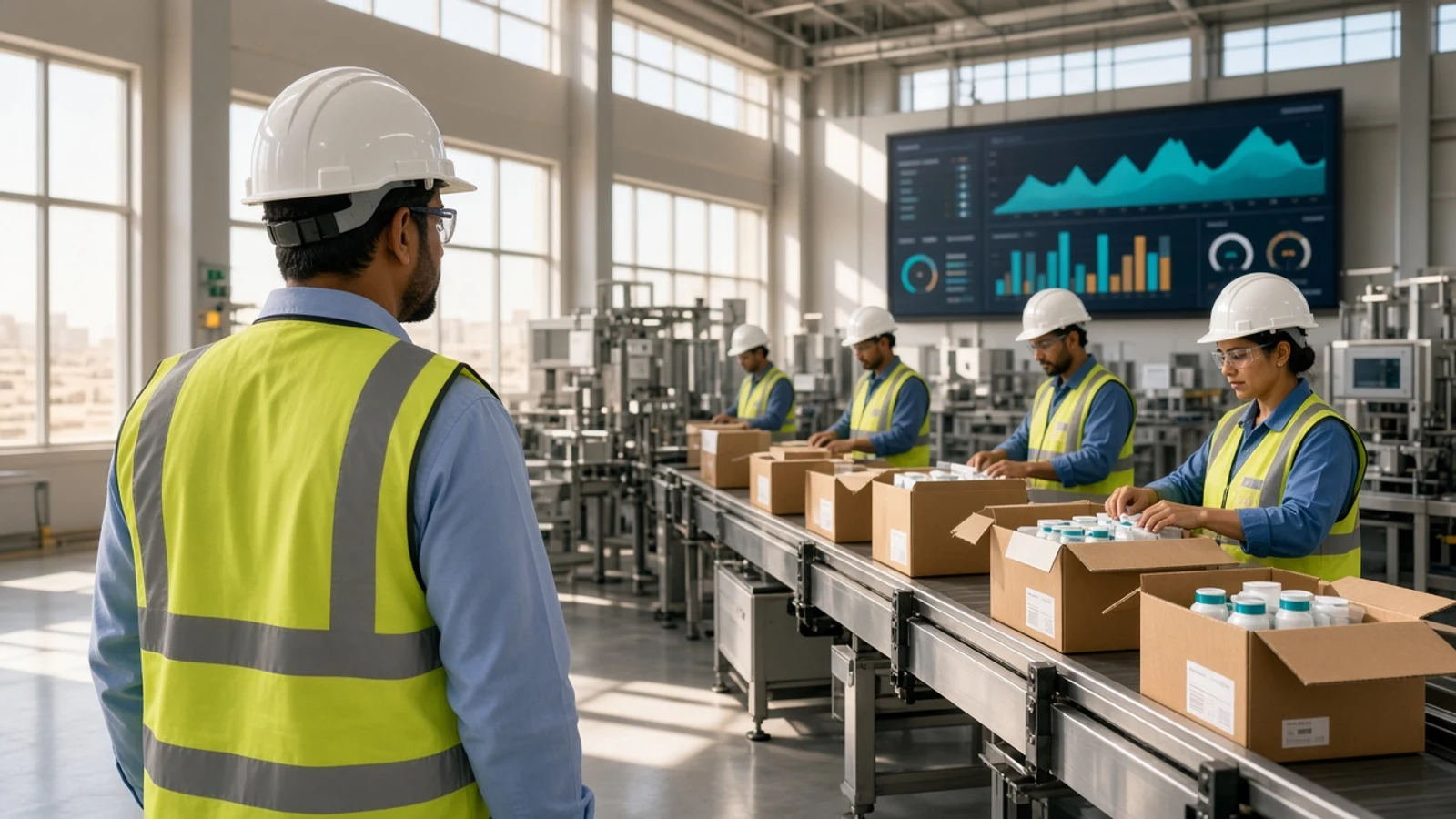
Key Takeaways
- A custom MES gives plants live production data, reliable batch records, and faster decisions, replacing spreadsheets and paper logs that cannot keep up with growth.
- Custom suits unique processes, mixed or older equipment, and fast growth plans. Off-the-shelf suits standard processes that need a quick launch on a limited budget.
- Core modules include scheduling, real-time monitoring and OEE, quality management, traceability, and inventory. Connecting them to ERP, SCADA, PLCs, and IoT sensors makes data trustworthy.
- Custom MES projects range from AED 20K to AED 150K+ and take two to twelve months or more. Start with a pilot line, then expand.
- Plan for industry rules, audit-ready records, and cybersecurity from day one. Choose a partner with manufacturing experience, clear contracts, source code ownership, and local support.
A factory floor produces thousands of small decisions every shift. Which machine runs next? Is this batch on spec? Why did line two stop?
In many UAE plants, those answers still live in spreadsheets, paper logs, and the memory of experienced supervisors.
A manufacturing execution system (MES) changes that. It tracks production in real time, from work orders to quality checks, and links the shop floor with your ERP. Off-the-shelf tools help, but a custom MES fits your processes, machines, and growth plans.
This guide explains how custom MES software works in the UAE, which features matter, how it connects to existing systems, what development costs are, and how to choose a partner, so you can plan your project with confidence.
What Is a Manufacturing Execution System (MES) and Why UAE Factories Need One?
A manufacturing execution system, or MES, is software that tracks and controls production on the factory floor in real time.
It links machines, people, and materials to your business systems, so managers see what is happening right now, not tomorrow.
1. Why ERP Alone Can't See the Shop Floor
ERP systems plan orders, inventory, and finances, but they rarely see what machines are doing. An MES fills that gap.
It captures real production data, feeds it back to ERP, and gives supervisors live status instead of end-of-shift paper reports.
2. Why Fast Industrial Growth Demands Real-Time Control
Growth adds lines, shifts, and complexity. The UAE's industrial sector now contributes about AED 200 billion to GDP, up roughly 70% since 2021, according to figures reported in May 2026. Paper logs cannot scale with that pace of factory output.
3. Why National Targets Raise the Bar for Every Plant
Operation 300bn aims to lift the industrial sector's GDP contribution from AED 133 billion to AED 300 billion by 2031.
Reaching that ambitious goal means higher output, tighter quality, and lower waste, which all depend on accurate, real-time production data.
4. Why Quality, Traceability, and Compliance Need Digital Records
Food, pharma, and chemical plants must prove what went into every batch.
An MES automatically records materials, machine settings, operators, and test results, so you can trace any lot in minutes, pass audits faster, and reduce costly product recalls.
Custom MES vs Off-the-Shelf MES: Which Fits Your Plant Best?
Choosing between custom and off-the-shelf MES shapes your costs, speed, and flexibility for years.
Many plants also want shop-floor mobile apps, often built by an enterprise software development company in Dubai. This comparison shows where each option really works best for your specific plant.
| Factor | Custom MES | Off-the-Shelf MES |
|---|---|---|
| Upfront Cost | Higher investment for planning, design, development, and testing | Lower starting cost, usually license fees plus implementation |
| Time to Launch | Takes several months, since the system is planned and built from scratch | Faster for standard setups, often weeks to a few months |
| Fit With Your Processes | Built around your exact workflows, routings, and quality checks | You adjust your processes to match the software's standard design |
| Customization and Flexibility | Features can change or grow as your production needs change | Limited to configuration options and the vendor's product roadmap |
| Integration With ERP, SCADA, and PLCs | Built to connect with your specific machines, including older equipment | Standard connectors work well, but unusual systems often cost extra |
| Scalability | Designed to expand across new lines, plants, and sites as you grow | Growth is tied to license tiers, user limits, and vendor capacity |
| Licensing and Recurring Fees | No per-user license fees, and you own the source code | Ongoing licenses or subscriptions that usually grow with users and sites |
| Data Ownership and Security Control | You choose hosting, access rules, and how production data is stored | Vendor hosting and policies apply, within the terms of your agreement |
| Maintenance and Support | Needs a support plan with your development partner, who sets priorities with you | Vendor provides updates and support, but on the vendor's own schedule |
| Best Suited For | Plants with unique processes, mixed or legacy equipment, and fast growth plans | Plants with standard processes that need a quick launch on a limited budget |
Core Modules and Features of a Modern MES Platform
A modern MES works as a set of connected modules, each handling one part of production. Together they give planners, supervisors, and operators one shared view of the plant. These are the core modules every manufacturing team should look for.
1. Production Scheduling and Work Order Management
Turn ERP orders into clear shop floor schedules. Planners assign work orders to lines and machines, track progress live, and reshuffle jobs when rush orders or breakdowns appear, so operators know what to run next and supervisors see delays early.
2. Real-Time Production Monitoring and OEE
Machines report status, output, and stoppages automatically. Dashboards show overall equipment effectiveness (OEE), cycle times, and downtime reasons by line and shift, helping teams spot bottlenecks within minutes instead of waiting for end-of-day reports and spreadsheet totals the next day.
3. Quality Management and Inspection
Build quality checks into the process. Operators log inspections on tablets, the system compares results with specifications, and out-of-range readings trigger alerts or holds. Statistical charts reveal trends early, reducing scrap, rework, and customer complaints before problems reach other batches.
4. Traceability and Batch Genealogy
Record which materials, machines, operators, and settings produced every lot. Barcode or QR scans link raw materials to finished goods, so if a defect appears, you can find affected products in minutes, limit recalls, and satisfy auditors and customers alike.
5. Inventory, Material, and Maintenance Management
Track raw materials, work in progress, and finished goods on the floor, with alerts before shortages stop a line.
Maintenance schedules and downtime logs help teams fix machines before they fail, extending equipment life and keeping planned production on track.
6. Reporting, Analytics, and Operator Interfaces
Role-based dashboards give managers KPIs, supervisors shift summaries, and operators simple touchscreen or mobile views with clear instructions.
Custom reports, alerts, and data exports turn raw production numbers into decisions, and they work in Arabic and English for mixed teams.
Integrating MES With ERP, SCADA, PLCs, and IoT Systems
Your MES is only as useful as the data it receives. Connecting it to ERP, SCADA, PLCs, and IoT sensors creates one live picture of the plant. Here's how each connection works, and what to plan for before you start.
1. Connect MES With ERP for Orders, Inventory, and Costs
ERP sends production orders and bills of materials down to the MES, and the MES returns actual quantities, scrap, and labor hours. This two-way link keeps finance and planning accurate, removes duplicate data entry, and lets managers cost every job.
2. Link SCADA and PLCs for Machine-Level Data
PLCs control machines, and SCADA supervises them. The MES reads cycle counts, alarms, and process values from both, and can send recipes or setpoints back. Clear rules for what the MES may change keep production safe and machine control reliable.
3. Extend Integration to People With APIs and Mobile Apps
Integration should reach people, not just machines. Custom ERP software development services in the UAE can add mobile apps for approvals, alerts, and inspections that read and write MES data through secure APIs, so supervisors respond quickly from anywhere on the floor.
4. Add IoT Sensors for Condition and Energy Data
IoT sensors add data that PLCs may not collect, such as vibration, temperature, humidity, and energy use. Streaming this data into the MES supports predictive maintenance, cold-chain monitoring, and energy tracking, which matter in UAE heat and for energy-heavy production.
5. Use Open Standards for Reliable Data Exchange
Open standards reduce custom wiring. OPC UA connects most modern controllers and SCADA systems, MQTT carries lightweight IoT messages, and REST APIs link business software. Choosing standards over one-off connectors makes upgrades easier and cuts long-term maintenance costs and effort.
6. Bring Legacy Machines Online With Gateways
Many plants run older machines without network ports. Protocol gateways, edge devices, and add-on sensors can read signals from them and translate the data for the MES, so you modernize step by step instead of replacing working equipment too early.
7. Secure Every Connection Between IT and OT
Connecting factory and business networks adds cyber risk. Separate operational and IT networks with firewalls, encrypt data in transit, use role-based access, and log every change. Follow IEC 62443 guidance so a breach in one area cannot halt all production.
8. Test, Phase, and Monitor Your Integrations
Integrate in phases. Start with one line and one data flow, test in a sandbox, and compare MES numbers with manual counts. Add monitoring for dropped connections and bad data, then expand line by line once results prove consistently reliable.
Custom MES Development Process: From Plant Assessment to Go-Live
An MES project touches machines, people, and data at once, so the order of work matters. A clear process keeps production running while the new system takes shape. Here is how a custom build moves from first walkthrough to go-live.
Stage 1: Plant Assessment and Goal Setting
Walk the floor with operators, supervisors, and managers. Map current workflows, paperwork, machines, and pain points like downtime or rework. Set clear goals, such as lower scrap or faster changeovers, so every later decision ties back to measurable business results.
Stage 2: Requirements and Scope
Turn findings into a written scope. List modules, user roles, reports, and integrations, then rank them as must-have, should-have, and later. A focused first release lowers risk, shortens delivery, and gives your whole team something genuinely useful to test early.
Stage 3: Architecture and Integration Planning
Design how the MES will connect to ERP, SCADA, PLCs, and sensors. Choose hosting, data models, and communication standards like OPC UA, and plan security between IT and factory networks. Good architecture now prevents expensive rework and delays after go-live.
Stage 4: Shop Floor UX Design
Operators work with gloves, noise, and tight time. Design large buttons, clear colors, simple screens, and Arabic and English options. Build clickable prototypes, test them with real operators on the floor, and fix confusing steps before any code is written.
Stage 5: Core Development in Sprints
Build the system in short sprints, starting with the modules that deliver the most value, such as work orders and production tracking. Hold regular demos for plant staff, so feedback shapes each release and surprises appear early, not at launch.
Stage 6: Dashboards, Web Portals, and Reporting
A custom software development company in Dubai can build the browser dashboards, supervisor portals, and reports that managers use daily. Make them fast, role-based, and mobile-friendly, so teams see live production data on any screen, anywhere in the whole plant.
Stage 7: Integration and Data Migration
Connect the MES to ERP, machines, and sensors one flow at a time. Migrate product data, routings, recipes, and inventory records, then check every number against source systems, so the team trusts what the new system reports from day one.
Stage 8: Testing and Validation
Test each module on its own, then run end-to-end scenarios: a full work order, a quality hold, a machine stop. Include load, security, and failure tests, and validate against regulated-industry requirements where needed, before any line depends on the system.
Stage 9: Training and Pilot Rollout
Train operators, supervisors, and maintenance staff on real scenarios, with short guides in Arabic and English. Pilot on one line first, run parallel with old methods for a short period, and fix issues quickly before expanding to other production lines.
Stage 10: Go-Live, Support, and Continuous Improvement
Roll out line by line, with engineers on the floor for the first shifts. After go-live, monitor performance, fix bugs fast, and review KPIs monthly. Add modules and integrations over time, so the MES keeps growing right with your plant.
Custom MES Development Cost and Timeline in the UAE
Custom MES projects typically range from AED 20K to AED 150K+, depending on plant size, lines, integrations, and modules.
Understanding custom software development cost in Dubai helps you compare options and plan phases. Here are the typical packages and timelines.
| Package | Price | Typical Timeline | Best For | What's Included |
|---|---|---|---|---|
| Basic MES (Starter) | AED 20K – AED 50K | 2 to 4 months | Small plants or a single pilot line replacing paper logs | Production tracking, work orders, basic OEE, simple quality checks, shift reports, one system integration |
| Mid-Level Business MES (Most Popular) | AED 50K – AED 90K | 4 to 8 months | Growing plants with several lines and ERP in place | Scheduling, quality management, batch traceability, ERP integration, role-based dashboards, Arabic and English screens, tablet and mobile access |
| Advanced Enterprise MES | AED 90K – AED 150K+ | 8 to 12+ months | Multi-plant operations and regulated industries like food and pharma | Enterprise architecture, multi-site support, SCADA, PLC, and IoT integration, advanced analytics, full batch genealogy, security hardening, validation support, ongoing support |
Compliance, Security, and How to Choose an MES Development Partner in the UAE
An MES holds your recipes, batch records, and production data, so compliance and security cannot be afterthoughts.
Some plants also ask about taxi booking app development services in the UAE for staff transport. Here's what to check, and who to trust.
1. Know the Rules for Your Industry
Rules depend on what you make. Pharmaceutical plants answer to the Emirates Drug Establishment, which issues GMP certification, while food makers typically follow HACCP and ISO 22000, and cosmetics makers ISO 22716. Tell your MES partner your sector very early.
2. Build Audit-Ready Records
Auditors want proof, not promises. Your MES should keep tamper-evident audit trails, timestamped records, electronic signatures, and version history for recipes and procedures. In regulated sectors, plan validation documents early, so inspections go smoothly and records stand up under scrutiny.
3. Protect Employee and Supplier Data
An MES stores employee names and shift data, which can count as personal data. The UAE's data protection law, Federal Decree-Law No. 45 of 2021, applies in many cases, though sources disagree on its executive regulations, so confirm with counsel.
4. Secure the Link Between IT and Factory Networks
Factory networks are now cyber targets. Follow IEC 62443 guidance: segment operational and IT networks, use multi-factor login, encrypt data, patch regularly, and monitor for unusual activity. A strong design stops a single breach from halting your entire production line.
5. Decide Where the System Will Run
Decide where the MES will run: on-premises, in the cloud, or hybrid. Many plants keep control systems on-site for speed and uptime, and use the cloud for analytics. Ask about offline mode, backups, and disaster recovery before you sign anything.
6. Look for Real Manufacturing Experience
Ask for proof of real manufacturing projects, not generic software. A good partner understands OEE, batch records, and ISA-95 concepts, can show similar plants, and offers references. Speak to the engineers who will build your system, not only sales staff.
7. Lock Down Ownership, Contracts, and Service Levels
Put key terms in writing: you own the source code, data, and documentation, with milestone-based payments, a clear scope, and a signed NDA. Agree on service levels for bug fixes, response times, and uptime, so support stays predictable after launch.
8. Check Local Support, Training, and the Roadmap
Check local support: engineers who can reach your plant fast, speak Arabic and English, and cover your shifts. Ask about operator training, documentation, and a roadmap for adding modules, so the system grows with your production instead of becoming outdated.
Final Thoughts
A custom MES gives your plant what spreadsheets and paper logs never can: live visibility, reliable records, and faster decisions. In the UAE, where industrial output is growing and quality expectations keep rising, that clarity becomes a real competitive edge.
Start with a clear assessment of your lines, machines, and goals. Build the most valuable modules first, connect them carefully to ERP, SCADA, and sensors, and pilot on one line before rolling out wider. Treat security, audit trails, and compliance as core design points.
Choose a partner with real manufacturing experience, clear pricing, and local support. With the right plan, your MES stops being a software project and becomes a daily tool that cuts waste, protects quality, and supports growth.
FAQs
1. What is a manufacturing execution system (MES)?
An MES is software that tracks and controls production on the factory floor in real time. It records orders, machine status, quality checks, and materials, and links the shop floor to ERP, so managers see current performance, not yesterday's numbers.
2. What is the difference between MES and ERP?
ERP manages business planning, finance, orders, and inventory. MES manages what happens on the shop floor, minute by minute. They work together: ERP sends orders down, and the MES reports actual production, scrap, and labor back for accurate job costing.
3. How much does a custom MES cost in the UAE?
Custom MES projects typically range from AED 20K to AED 150K+, depending on plant size, lines, modules, and integrations. Hardware, sensors, licenses, and validation work are usually separate. Final pricing comes after a plant assessment of your current shop floor.
4. How long does it take to build a custom MES?
A starter MES for one line often takes two to four months. Mid-level systems with several lines and ERP integration take four to eight months, while enterprise, multi-site projects can take eight to twelve months or longer, depending on scope.
5. Should I build a custom MES or buy off-the-shelf?
Choose custom if you have unique processes, older machines, or fast growth plans. Off-the-shelf works for standard processes and quick launches. Many plants compare both on cost, fit, integration needs, and long-term license fees before making a final investment decision.
6. Can an MES connect to my existing machines and ERP?
Yes. Most connect to ERP through APIs, and to PLCs and SCADA through standards like OPC UA. Older machines can often be linked using gateways or add-on sensors, so you can modernize step by step without replacing good working equipment.
7. Is a custom MES secure?
It can be, if designed properly. Good practice includes IEC 62443 guidance, separate IT and factory networks, multi-factor login, encryption, role-based access, regular patching, and monitoring. Ask your partner for security testing results before go-live, then repeat tests every year.
8. Do UAE factories need an MES for GMP or food safety compliance?
No rule requires an MES by name, but it makes compliance far easier. Pharma, food, and cosmetics plants need accurate records and traceability, and an MES provides audit trails, batch genealogy, and electronic records automatically. Check your sector's rules first.
9. How do I choose an MES development partner in the UAE?
Look for real manufacturing projects, references, and engineers who understand OEE, batch records, and ISA-95. Check local support, Arabic and English training, security practices, and contract terms, including source code ownership, before you sign. Start with one small pilot line.
10. What are common mistakes when implementing an MES?
Common mistakes include trying to build everything at once, skipping operator input, ignoring data quality, underestimating integration work, and weak training. Start with one line, involve operators early, and expand module by module as results prove their real business value.